AI Deepfake Invoice Fraud: How Businesses Can Protect Accounts Payable Teams
Artificial intelligence is changing the way businesses operate — but it’s also transforming the way cybercriminals commit fraud.
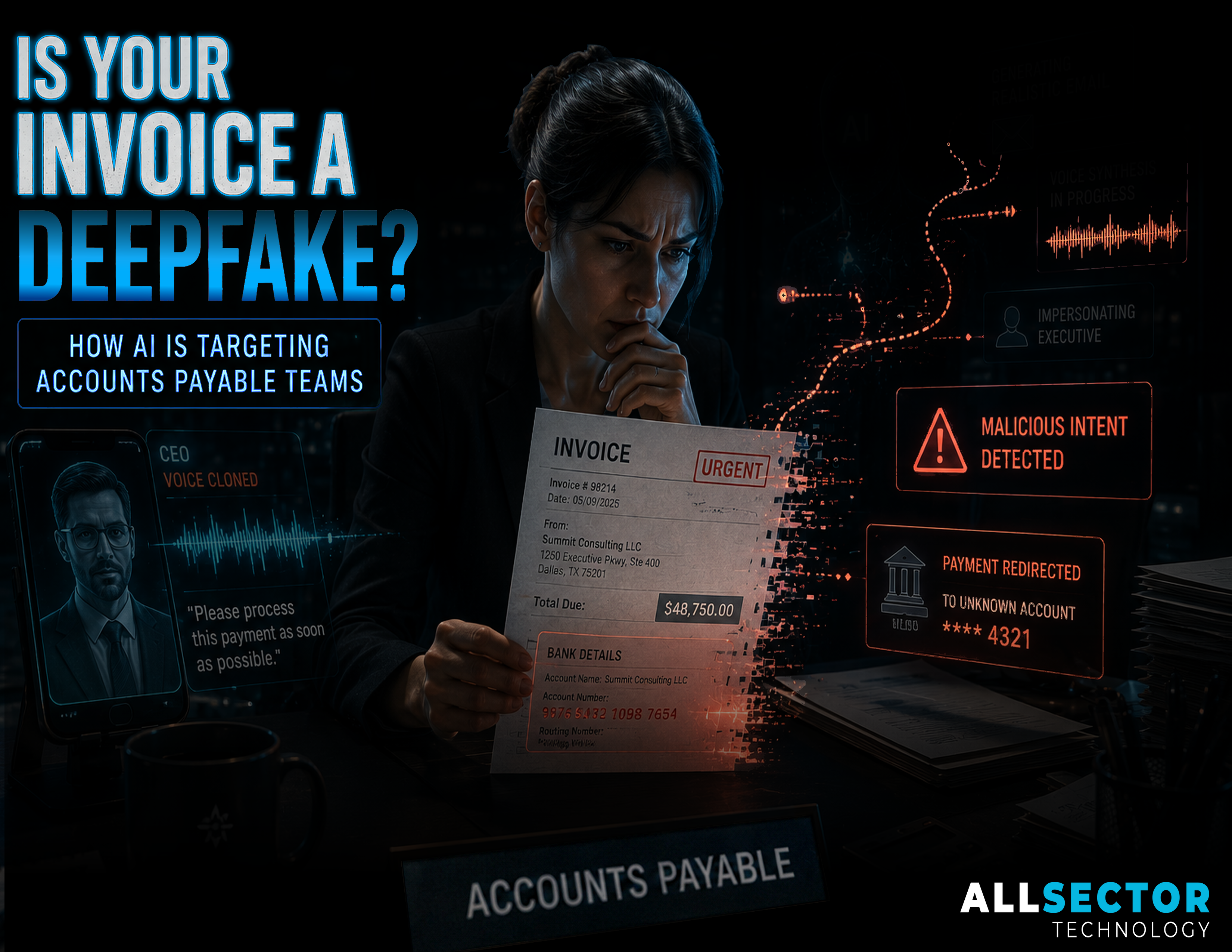
Today’s attackers no longer rely solely on poorly written phishing emails or obvious scams. Modern cybercriminals are using AI to generate convincing business emails, clone executive voices, imitate writing styles, and manipulate payment workflows with alarming accuracy.
For finance departments and Accounts Payable (AP) teams, this creates a growing cybersecurity threat that many organizations are not fully prepared for.
An urgent email requesting a wire transfer may appear completely legitimate. A voicemail from a company executive may sound authentic. A supplier invoice may match prior communications perfectly.
But in many cases, these requests are fraudulent.
At AllSector Technology, we help Long Island businesses strengthen cybersecurity defenses against modern AI-enhanced threats through proactive security strategies, managed IT services, employee awareness training, and fraud prevention controls.
In this article, we’ll explain:
- How AI-powered invoice fraud works
- Why AP teams are increasingly targeted
- How voice cloning and deepfake scams bypass traditional warning signs
- Why businesses need stronger payment verification workflows
- Best practices to reduce financial fraud risk
Why Accounts Payable Teams Are Prime Targets
Cybercriminals focus on Accounts Payable departments because they sit directly between trust and money.
AP teams:
- Process invoices daily
- Manage vendor relationships
- Handle banking information
- Execute wire transfers
- Respond to urgent financial requests
- Operate under tight deadlines
Attackers understand that busy finance teams often prioritize speed and operational continuity. AI now helps criminals exploit that environment more effectively than ever before.
Unlike ransomware or network intrusions, Business Email Compromise (BEC) attacks often require little technical hacking at all.
Instead, attackers manipulate people and processes.
How AI Is Changing Financial Fraud
Traditional phishing attacks were often easy to spot due to:
- Poor grammar
- Generic greetings
- Suspicious formatting
- Obvious sender mismatches
AI has changed that dramatically.
Modern fraud attempts can now:
- Mimic executive communication styles
- Generate realistic business language
- Reference real projects or invoices
- Replicate supplier communication patterns
- Clone human voices with minimal audio samples
The result is a new generation of fraud attempts that blend directly into normal business operations.
AI-Generated Business Email Compromise (BEC)
Business Email Compromise remains one of the most financially damaging cyber threats affecting organizations today.
Attackers commonly impersonate:
- CEOs
- CFOs
- Vendors
- Clients
- Internal finance staff
- Trusted partners
Using AI tools, attackers can now produce highly personalized emails that appear almost indistinguishable from legitimate business communications.
These emails often:
- Reference current invoices
- Mimic executive urgency
- Include accurate branding
- Match writing tone and formatting
- Use realistic signatures and workflows
For AP teams handling hundreds of messages daily, these scams are becoming increasingly difficult to identify through instinct alone.
Invoice Redirection Fraud Is Increasing
One of the most common deepfake-enabled fraud techniques involves changing payment destinations.
Attackers may:
- Intercept legitimate invoice conversations
- Monitor communication patterns
- Replace banking details
- Reissue modified invoices
- Request urgent payment updates
Because portions of the communication may actually be legitimate, the fraudulent request can appear completely authentic.
Even experienced employees can miss subtle changes when operating under pressure.
AI Voice Cloning Is Changing Executive Fraud
Perhaps the most alarming development is AI-powered voice cloning.
Cybercriminals can now recreate a person’s voice using only a short audio sample collected from:
- Social media videos
- Zoom recordings
- Webinars
- Voicemails
- Podcasts
- Public interviews
Attackers may then place calls impersonating:
- Company executives
- Financial controllers
- Vendors
- Business owners
A finance employee may receive what sounds like a legitimate urgent payment approval directly from leadership.
The psychological pressure of urgency combined with a familiar voice makes these scams highly effective.
Why Traditional Fraud Detection Methods Are Failing
Businesses can no longer rely solely on employees “spotting suspicious emails.”
AI-generated scams often eliminate the traditional warning signs that awareness training once emphasized.
Today’s attacks are:
- Grammatically correct
- Contextually accurate
- Personalized
- Professionally formatted
- Emotionally convincing
This means cybersecurity must shift away from relying entirely on human judgment.
The strongest defenses now focus on process verification instead of visual detection.
How Businesses Can Reduce AI-Driven Payment Fraud
At AllSector Technology, we help businesses strengthen financial security through layered cybersecurity and operational safeguards.
The goal is not to make employees paranoid. The goal is to build verification processes that remain effective even when scams appear convincing.
Implement Out-of-Band Verification
Every request involving:
- Bank detail changes
- Wire transfers
- Payment rerouting
- Urgent payment approvals
- Vendor account updates
should require independent verification through a separate communication channel.
This may include:
- Calling a verified phone number already on file
- Confirming directly with known contacts
- Using internal approval systems
- Requiring secondary approvals
Critically, verification should never rely on replying to the same email thread where the request originated.
Strengthen Identity Security with MFA
Multi-factor authentication remains one of the most effective ways to reduce account compromise risks.
Businesses should implement:
- MFA for email accounts
- MFA for accounting systems
- Conditional access policies
- Role-based access controls
- Password managers
- Login anomaly monitoring
Even if credentials are stolen, MFA creates an additional barrier that helps stop attackers from escalating access.
Limit Access to Financial Systems
Businesses should apply the principle of least privilege.
Not every employee requires access to:
- Banking systems
- Vendor payment tools
- Accounting platforms
- Financial approval workflows
Reducing unnecessary access limits exposure if accounts become compromised.
Build a Culture Where Verification Is Encouraged
One of the most overlooked cybersecurity protections is company culture.
Employees should feel comfortable:
- Questioning urgent requests
- Verifying executive instructions
- Slowing down high-risk actions
- Escalating suspicious communications
At AllSector Technology, we encourage businesses to create environments where security verification is viewed as responsible — not disruptive.
Employee Awareness Training Still Matters
While AI scams are more advanced, employee cybersecurity awareness remains essential.
Training should include:
- AI-generated phishing awareness
- Voice cloning fraud examples
- BEC attack scenarios
- Invoice fraud red flags
- Vendor impersonation tactics
- Secure payment verification procedures
Modern awareness training should focus on process discipline, not just spotting suspicious emails.
AI Fraud Will Continue to Evolve
AI-powered fraud is not a temporary trend.
As deepfake technology becomes more accessible, businesses of every size will face increasing pressure to modernize payment verification and cybersecurity controls.
The organizations best positioned to reduce risk are the ones that:
- Build layered approval processes
- Verify independently
- Strengthen identity security
- Reduce unnecessary trust assumptions
- Train employees continuously
- Partner with experienced cybersecurity providers
Protect Your Business from AI-Driven Financial Fraud
Concerned about deepfake scams, invoice fraud, or Business Email Compromise attacks targeting your organization?
AllSector Technology helps Long Island businesses strengthen cybersecurity defenses with managed IT services, phishing protection, identity security, employee awareness training, and proactive fraud prevention strategies.
Contact our team today to schedule a cybersecurity and payment workflow assessment.
Website: https://allsector.com
Phone: 866-783-6648
EMail: Info@allsector.com